
Freya Sullivan · 11 September 2026
Navigating Backend Infrastructure Shifts and Their Effects on Long-Term Performance Benchmarks in Digital Platforms
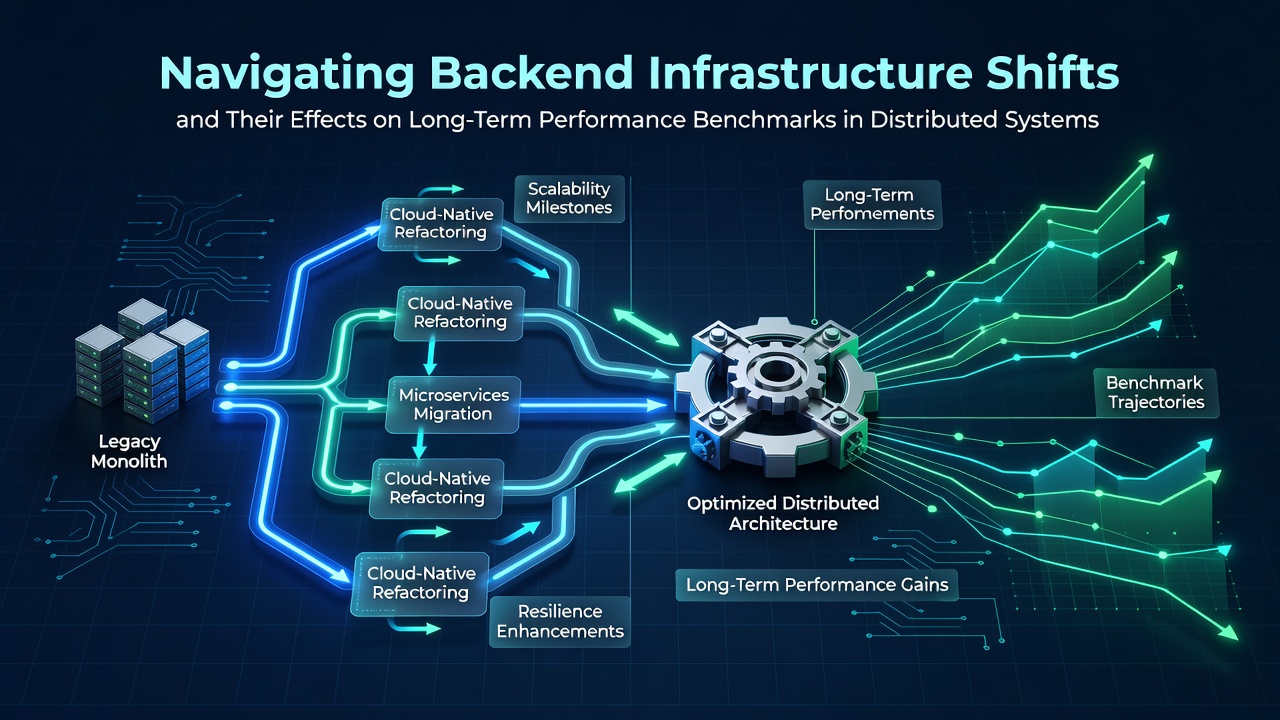
Backend infrastructure shifts occur when organizations transition from monolithic architectures to distributed systems, adopt cloud-native services, or implement container orchestration platforms, and these changes alter how performance benchmarks evolve over extended periods. Data from industry reports indicate that such migrations often involve replacing physical servers with virtual instances or moving workloads to managed environments, which affects metrics like response times, throughput rates, and resource utilization patterns. Researchers have documented cases where initial benchmarks show improvements in scalability, yet long-term tracking reveals shifts in latency due to network overhead and dependency management.
Common Types of Backend Infrastructure Changes
Organizations frequently undertake migrations to microservices architectures, where applications break into independent components that communicate through APIs, and this approach allows teams to scale individual services based on demand. Another prevalent shift involves adopting serverless computing models, in which providers handle server provisioning, and functions execute on demand without dedicated infrastructure. Data shows these transitions impact benchmarks differently depending on workload characteristics, with compute-intensive tasks sometimes experiencing variable performance when cold starts introduce delays.
Containerization through tools like Kubernetes represents a third category of change, and it enables consistent deployment across environments while introducing overhead from orchestration layers. Observers note that companies implementing these systems report benchmark data that fluctuates during the stabilization phase, after which patterns stabilize if proper resource limits and autoscaling rules remain in place. Studies from academic institutions highlight how database layer modifications, such as shifting from relational to NoSQL stores, further influence query performance over multi-year horizons.
Measuring Long-Term Performance Benchmarks
Performance benchmarks in digital platforms rely on consistent metrics including average latency, error rates, and requests per second, yet infrastructure shifts require recalibration of these indicators to account for new variables. Long-term analysis involves collecting data across months or years, and this process reveals trends that short-term tests miss, such as gradual degradation from accumulated technical debt or evolving traffic patterns. Figures from monitoring platforms demonstrate that platforms undergoing shifts often establish new baselines after six to twelve months, allowing accurate comparisons against prior states.
Tools for tracking these benchmarks include application performance management software that aggregates logs and traces, and they provide visibility into how infrastructure changes propagate through systems. Research indicates that effective measurement requires synthetic monitoring alongside real-user data, because the combination captures both controlled scenarios and production variability. As preparations advance toward platform updates projected for September 2026, teams continue refining these measurement frameworks to capture evolving conditions.
Factors Influencing Benchmark Outcomes
Network configuration plays a central role in post-shift performance, since increased reliance on external services introduces latency from data transfer across regions. Resource allocation strategies, including memory and CPU limits in containerized setups, determine whether benchmarks maintain stability under load, and improper settings lead to throttling that compounds over time. Observers have noted that caching layers added during infrastructure updates often improve initial response times, but their effectiveness depends on invalidation policies that adapt to changing data patterns.
Security enhancements incorporated during shifts, such as encryption at rest and in transit, add computational overhead that appears in benchmark results, although optimized implementations minimize these effects. Data from government sources including the National Institute of Standards and Technology outlines best practices for evaluating these trade-offs through standardized testing protocols. Geographic distribution of workloads also matters, because latency-sensitive applications perform differently when infrastructure spans multiple availability zones or cloud providers.
Case Examples from Digital Platforms
One documented transition involved a content delivery network that moved from dedicated hardware to cloud-based edge computing, and subsequent benchmarks showed sustained throughput gains after initial adjustment periods. Another instance featured an e-commerce platform that adopted event-driven architectures, resulting in improved scalability during peak events while requiring ongoing adjustments to message queue configurations. Research from Canadian academic sources on similar migrations indicates that platforms achieving stable long-term benchmarks invest in automated testing suites that run continuously after infrastructure changes.
These examples illustrate how benchmark trajectories depend on the thoroughness of pre-migration planning and post-implementation tuning. Teams that incorporate feedback loops from monitoring data tend to see benchmarks converge toward predictable ranges faster than those relying on manual interventions alone.
Strategies for Managing Benchmark Stability
Continuous integration pipelines that include performance regression tests help detect benchmark deviations early after infrastructure shifts, adn they allow rapid remediation before issues affect users. Capacity planning models updated to reflect new resource consumption patterns provide guidance for scaling decisions, and these models draw from historical data collected across multiple quarters. Organizations also benefit from establishing cross-functional teams that combine infrastructure specialists with application developers, since this collaboration ensures benchmarks reflect both system-level and code-level factors.
Documentation of each shift phase, including rollback procedures, supports consistent benchmark tracking by preserving context for future analysis. External references such as reports from the Cloud Native Computing Foundation supply frameworks for evaluating infrastructure decisions against established performance criteria. Over time these approaches contribute to benchmarks that remain reliable indicators of platform health despite ongoing changes.
Conclusion
Backend infrastructure shifts reshape the foundation upon which digital platforms operate, and their effects on long-term performance benchmarks emerge through systematic measurement and adjustment. Data from multiple sectors confirms that careful attention to metrics, combined with adaptive strategies, supports sustained benchmark reliability. Platforms that integrate these practices position themselves to handle future evolutions while maintaining observable performance standards.